Walls That Do the Talking: A Walking Guide to the Murals Denver Actually Uses as Landmarks
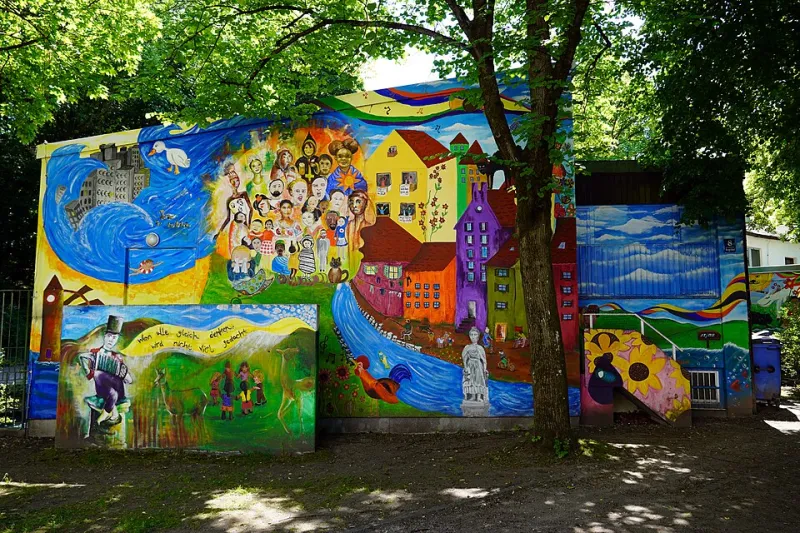
Photo: Allie_Caulfield, CC BY 2.0, via Wikimedia Commons
Ask someone in Five Points to meet you and they may not give you an address. They'll say: by the wall with the saxophone.
That's the thing about Denver's street art that thumbnails on a tourism site never quite capture. The murals aren't decoration sitting on top of the neighborhood. They're infrastructure. They're how people navigate, how they remember, and — increasingly — how they sell.
Here's a walking tour of the walls that function as wayfinding, and what the people who live near them say about it.
The anchor on Larimer
The big, unmistakable one in RiNo. You know the one — the abstract face that has appeared in roughly nine million engagement photos. It works as a landmark precisely because it's visible from a block away and it never moves, even as everything around it does.
"I've given directions using that wall for eleven years," said Renata, who manages a coffee shop two doors down. "Before that mural, nobody could find us. Now I say 'half a block from the face' and people walk in."
It's also the mural most likely to be cited in the argument about RiNo's transformation — the way a district branded itself on its artists and then priced many of them out. More on that below.
The jazz wall on Welton
Five Points has a long, well-documented history as a music corridor, and the murals along Welton Street read like a citation list. Portraits of players, painted horns, text pulled from old marquees. Tour guides stop here because the images do the storytelling for them.
What's less obvious to visitors: locals use these walls as meeting points because they're recognizable at a glance and they sit at genuinely useful intersections. A wall becomes a landmark when it's positioned where decisions happen.
The corridor out west
Morrison Road has quietly become one of the most consistent stretches of public art in the metro — not a single destination wall, but a rhythm of them, tucked between taquerias, auto shops, and family businesses. Artists here have described the work as community-facing first and photograph-facing second, which is a meaningful distinction in a city where a mural's Instagram value can start to feel like its whole job.
"We didn't paint it so people from the suburbs would drive down," one muralist told me, asking that I not attribute the quote to a specific wall. "We painted it so the kids walking to school see themselves on the way."
The alley grid on South Broadway
Broadway's side streets and back lots hold a scatter of smaller pieces — dumpster covers, garage doors, the entire rear wall of a record shop. These are the murals that get repainted most often, which makes them a decent barometer of how fast a block is changing. A wall that's been tagged over and re-done three times in two years tells you something about foot traffic, and about who feels ownership of the space.
The practical function here is underrated. Alleys are confusing. A wall of color gives you a reference point where a GPS just says 'arrive.'
The corner that's become a photo line
Every city now has at least one mural that generates a queue on Saturday afternoons. Denver has several. Business owners on those blocks describe a complicated blessing: the foot traffic is real, the spillover into shops is real, and so is the friction — people standing in the street, tripods on the sidewalk, neighbors who can no longer park in front of their own building.
One shop owner on a heavily photographed block told me she now plans staffing around weather forecasts, because a sunny weekend means a line.
The ones that disappear
Here's the honest part. Murals are as permanent as paint on a wall that someone else owns. When a building sells, a wall comes down or gets covered. Artists have watched years of work vanish with a coat of primer and no conversation, which is why some now write contracts with removal clauses and others simply paint with the assumption that it's temporary.
That impermanence is part of the appeal, and part of the loss. A neighborhood's visual memory gets rewritten on the landlord's timeline.
How to read the walls
A few practical notes if you want to walk this city by mural rather than by map.
- Treat the art as someone's front yard, not a backdrop. Step out of the doorway.
- Buy something if you're lingering on a commercial block. It goes a long way.
- Look for the small pieces — the utility box, the roll-down gate, the low wall by the bus stop. Those are usually the ones painted by people who live there.
- Notice who's depicted. The walls that show a neighborhood's own history are telling you something about who fought to keep it visible.
Denver's murals work as a navigation system because they're local knowledge made visible — a way of saying 'this is where we are' in a city that keeps rearranging itself. The paint will fade. The directions will change. For now, the walls are still talking, and the people walking past them still know what they mean.