Same Storm, Two Cities: What Denver's Snow Days Quietly Reveal About Who Works Through Them
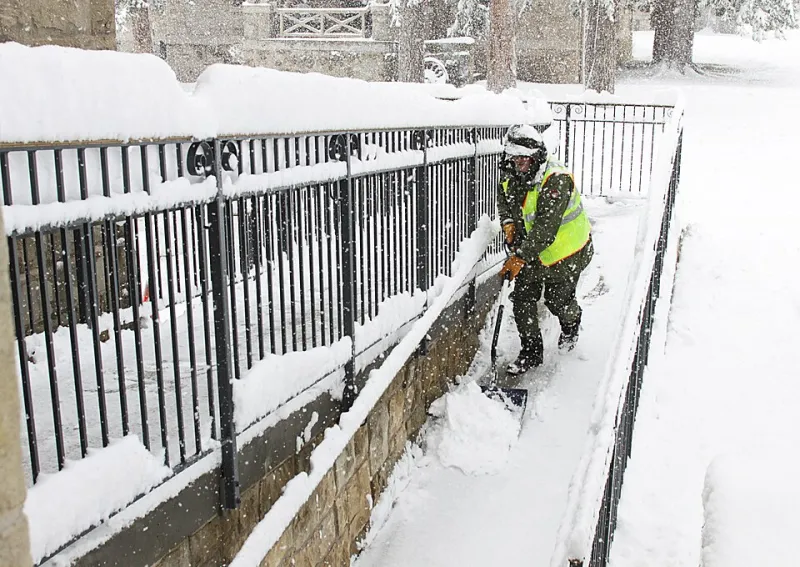
Photo: NPS/Jim Peaco, Public domain, via Wikimedia Commons
There's a particular joy, familiar to anyone who's lived through a Front Range spring, in waking up to a March snowstorm and the two-word miracle that follows: snow day. Schools close. Meetings go remote. The city exhales, grabs a sled, and posts it all online under a caption about how much we love it here — four sunny days, then a powder morning, what a town.
But the snow day was never universal. It only ever applied to some of us. And the storm that just buried the metro area made that impossible to ignore.
Who Got the Day Off — And Who Got the Shift
By 7 AM, the familiar split was already underway. Office workers across the city saw calendar invites turn to 'canceled' and rolled back over. Meanwhile, a parallel Denver was already out the door: the plow operators who'd been on shift since midnight, the crews clearing hospital parking lots, the grocery stockers facing down shelves stripped by panicked shoppers the night before.
The barista didn't get a snow day — she got a text asking if she could come in early because the morning rush would be all delivery drivers and shift workers who also didn't get the day off. The home health aide navigated unplowed side streets because the person she cares for doesn't pause because of weather. The Amazon driver, the line cook, the nurse, the rideshare guy digging out his car with a plastic spatula: all present. All essential, as we learned to say a few years ago, and then quietly stopped saying.
The Myth of the Shared Experience
Denver's self-image leans hard on weather. We're the city that plays outside, that doesn't let a little snow slow us down, that shrugs at a polar vortex. It's a charming story, and partly true. But it papers over the fact that 'not slowing down' means something very different depending on your job.
For one tier of workers, the storm is a novelty — a cozy interruption, a bonus day, a photo of the backyard. For another, it's a wage calculation. Hourly workers don't get paid for snow days. Closing early means closing short. And calling out, for the many who don't have paid leave, means choosing between a slippery commute and a missing chunk of rent.
We experienced the exact same weather and lived in two different cities.
What a Fair Snow Day Would Look Like
This isn't an argument against the joy of a snow day. It's an argument that the joy should be distributed more honestly. A handful of large employers and cities elsewhere have started experimenting with emergency weather pay — guaranteeing hourly workers their scheduled wages when closures happen. Colorado's legislature has flirted with paid leave expansions that would soften these shocks. It's a start, but for most of the workers who kept this city functioning last week, the storm remains an unpaid risk they absorb personally.
There's also a simpler ask: notice. If your snow day was made possible by someone else's commute, tip like it. Thank the driver, the plow operator, the person behind the counter at 6 AM because your kid's school closed and your office didn't.
Sunny Days and Uneven Ones
Denver's best quality, the thing locals defend most fiercely, is that it's a city built on optimism — 300 days of sunshine, mountains in every direction, weather that never keeps anyone down. That optimism is real. But so is the two-tiered experience underneath it.
The next time the snow flies, look out your window and ask who's out there keeping your snow day possible. Then ask what it would take for the next storm to actually be a day off — for everyone. That's the city we like to think we are. The storm just shows us how far we still are from being it.