The Quiet Keepers: Denver's Underground Historians Are Saving Stories the City Would Rather Forget
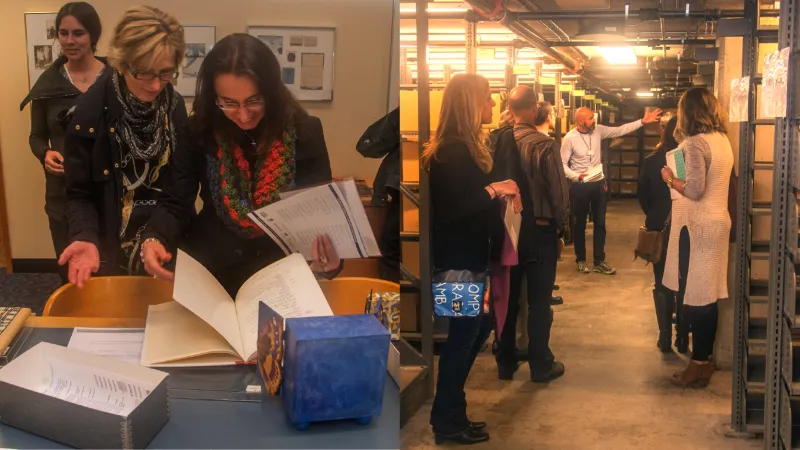
Photo: community archivist organizing historical documents library Denver, via www.tedxmilehigh.com
Somewhere in a Five Points apartment, a retired schoolteacher has spent the last six years recording conversations with elderly residents who remember what the neighborhood looked like before the light rail came through and the cocktail bars moved in. She doesn't have a grant. She doesn't have a publisher. She has a decent USB microphone, a external hard drive she backs up obsessively, and a genuine terror that these voices will vanish before anyone thinks to write them down.
She's not alone.
Across Denver, a loose and largely invisible network of people — independent reporters, self-funded documentarians, museum volunteers, neighborhood historians, and community librarians — are doing the unglamorous work of keeping this city's real history intact. Not the version that ends up on a tourism website or a Chamber of Commerce brochure. The version with friction in it. The version that includes who got pushed out, who got overlooked, and who built something meaningful in a neighborhood that the city's official narrative barely acknowledges.
These are the people we rarely think to thank. And right now, their work has never mattered more.
Why the Mainstream Can't Do This Alone
Let's be honest about something: traditional local media in Denver, like in most American cities, has contracted significantly over the past two decades. Newsrooms that once had dedicated beat reporters covering specific neighborhoods, cultural communities, or city institutions have had to consolidate, cut, and prioritize stories with the broadest possible reach. That's not a moral failure — it's a resource problem. But it does leave gaps.
Those gaps are where the quiet keepers operate.
Take the independent reporters who cover Denver's unhoused population not as a political issue but as a human one — sitting with people under overpasses, learning their names, understanding their histories. Or the archivists at smaller institutions like the Blair-Caldwell African American Research Library, who are actively digitizing materials that document Black Denver's cultural and political life in ways that larger institutions have historically deprioritized. These folks aren't waiting for an assignment editor to greenlight their work. They're doing it because they understand something urgent: cities transform fast, and memory is fragile.
The Race Against the Wrecking Ball
Denver is in the middle of one of the most aggressive physical transformations in its history. Whole blocks that looked one way a decade ago are unrecognizable now. With that physical change comes a quieter erasure — the loss of the social fabric, the community anchors, the corner stores and barbershops and church basements where real neighborhood life happened.
Oral historians and community documentarians will tell you the same thing: the window to capture these stories is closing faster than most people realize. Elderly residents who hold living memory of mid-century Denver — its segregated swimming pools, its jazz clubs, its labor movements, its Chicano murals — are aging out. Every year that passes without someone sitting down with a recorder and asking the right questions is a year of irreplaceable context gone.
One longtime archivist connected to the Denver Public Library's Western History and Genealogy department put it plainly in a conversation we had recently: "We're not just collecting documents. We're collecting the interpretation of those documents. The person who lived through something understands it in a way that a newspaper clipping never fully captures."
That's the work. And it's painstaking, underfunded, and chronically underappreciated.
Outside the Institution, Inside the Community
What makes Denver's informal preservation network distinct is how much of it operates outside traditional institutional structures — and how that actually makes it more effective in certain communities.
Formal archives and museums carry their own historical baggage. For communities that have had complicated relationships with official institutions — Indigenous communities, communities of color, immigrant communities — a city archivist with a badge and a form to fill out isn't always the most trusted figure in the room. But a neighbor with a camera and a genuine relationship with the block? That's a different conversation.
Several community documentarians working in Denver's Globeville and Elyria-Swansea neighborhoods — areas that have faced decades of environmental injustice and are now squarely in the path of ongoing development pressure — have built their archives specifically by being embedded in those communities long-term. They show up at community meetings. They help families scan old photographs. They translate documents. The archive grows because the trust is already there.
This model doesn't scale easily, and it doesn't generate a lot of visibility. But it produces something that top-down institutional collection often can't: a record that the community itself recognizes as true.
The Tools Are Cheap. The Time Isn't.
One thing worth acknowledging is that the democratization of recording technology has genuinely helped this work. A decent oral history setup — a laptop, a quality USB mic, a free audio editing program — costs a few hundred dollars. Digital photography has made visual documentation accessible in ways that darkrooms and film costs never allowed. Community newsletters and independent websites have replaced the need for a printing press.
But none of that changes the fundamental scarcity: time. The people doing this work are often doing it around full-time jobs, family obligations, and the general exhaustion of living in an expensive city. Grant funding exists, but it's competitive and inconsistent. Many of Denver's most dedicated community historians have gone years without any financial support for their work, relying on personal savings or the generosity of community members who understand what's being built.
The irony is that the city itself — which spends considerable resources on marketing its own history and culture — has sometimes been slow to recognize or support the people doing the most granular preservation work at the neighborhood level.
What Gets Saved, and What Gets Lost
Here's the uncomfortable truth that anyone working in this space will tell you: not everything gets saved. Decisions about what to document are always decisions about what matters, and those decisions are shaped by who has the time, the access, and the resources to do the work.
That means some stories get captured and some don't. Some neighborhoods have a dedicated archivist and some don't. Some communities have elders who were told their whole lives that their stories were worth writing down, and some have elders who were told the opposite.
The quiet keepers of Denver are working against that imbalance, but they're working against it with limited capacity and infinite need. What they're building — block by block, interview by interview, photograph by photograph — is a counterweight to the official version of this city's story. A version that's messier, more honest, and a lot harder to sanitize for a real estate brochure.
If you've never heard of them, that's kind of the point. They're not doing this for recognition. They're doing it because someone has to, and because the alternative — a city that only remembers itself the way it wants to be remembered — is a city that's already lost something essential.
Next time you're in Five Points or Globeville or Westwood, pay attention to who's paying attention. Chances are, someone nearby is making sure this moment doesn't disappear entirely. And Denver is better for it, even if Denver doesn't always know their name.