Roots and Rent: The Long-Timers Denver Is Quietly Leaving Behind
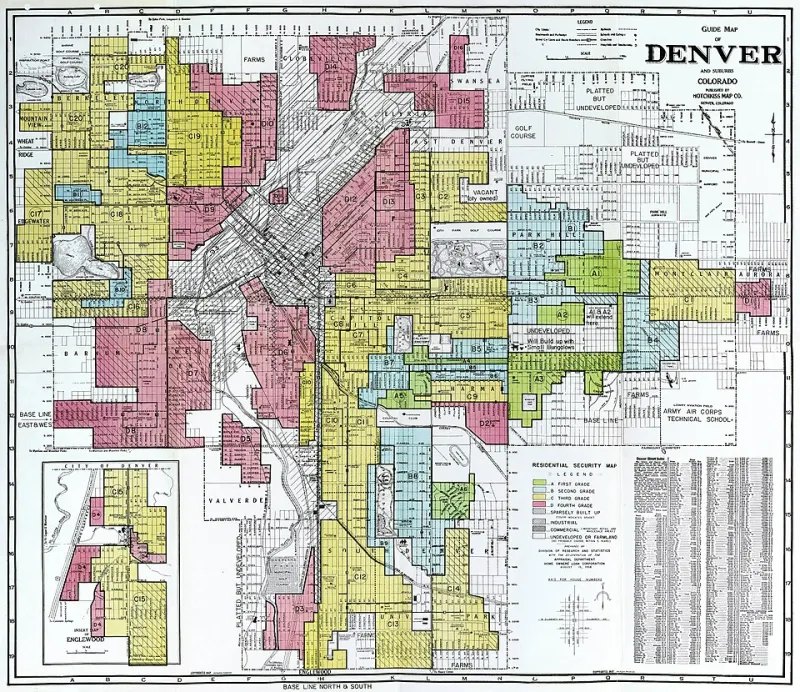
Photo: Home Owners' Loan Corporation, Public domain, via Wikimedia Commons
Sandra Reyes has lived in the same Globeville rental house for fourteen years. She's watched the neighborhood shift from a place most Denverites couldn't point to on a map to something developers now call "an emerging corridor." Last spring, her landlord handed her a lease renewal with a $600-a-month increase. She's a home health aide. She didn't have $600 a month.
"I built my whole life here," she said. "My kids went to school two blocks away. My church is down the street. And now I'm supposed to just — go where?"
Sandra isn't an outlier. She's a pattern.
The Numbers Behind the Displacement
Denver's rental market has been on a decade-long tear. According to data from the Colorado Department of Local Affairs, median rent in Denver proper climbed more than 70 percent between 2012 and 2023. That's not a blip — that's a structural shift in who can actually afford to live here.
What makes it especially brutal for long-term renters is the way appreciation compounds. A landlord sitting on a property that's doubled in value has every financial incentive to reset rents to market rate, especially when Colorado offers no statewide rent control protections. Local governments are largely barred from enacting their own caps under a 1981 state preemption law — one that housing advocates have been fighting to overturn for years without success.
For someone who signed a lease in 2013 and enjoyed modest annual increases, the jump to current market rates can feel like falling off a cliff. We're talking $400, $600, sometimes $900 more per month — overnight.
"I Thought Staying Loyal Meant Something"
That's how Marcus Tillman, a 58-year-old electrician who's rented in Park Hill for eleven years, describes it. He'd been a model tenant — never late, kept the place up, knew the neighbors by name. When his landlord sold the property to an out-of-state investment group in 2022, the new owners raised his rent by $525 the following year.
"I thought staying loyal meant something," Marcus said. "It doesn't. You're just a line item."
This is one of the more underreported dimensions of Denver's housing crisis: the psychological toll. Long-term renters often operate under the assumption that stability is its own kind of equity. They invest in their neighborhoods — through relationships, through local businesses they frequent, through the informal networks that hold communities together. When that investment gets wiped out by a lease renewal letter, the loss isn't just financial.
Dr. Priya Mehta, a urban sociology researcher at the University of Denver, calls it "displacement grief." It's the mourning of a place that still technically exists but no longer has room for you.
"We talk a lot about gentrification in the abstract," Mehta said. "But what we're really talking about is the erasure of social infrastructure — the people who've been quietly holding a neighborhood's identity together for years. When they leave, something goes with them that you can't rebuild."
Where Do People Actually Go?
The honest answer: further out, or out of Colorado entirely.
Aurora has absorbed a significant number of displaced Denver renters over the past five years, but rents there are climbing too. Commerce City, Thornton, even Pueblo — these are the places people mention when they describe where they ended up after a displacement event. Some land with family. Some end up in situations that are technically housing but don't really feel like home.
A 2023 report from the Denver Metro Fair Housing Center found that renters displaced from gentrifying neighborhoods were significantly less likely to remain in the same school district, maintain the same employment, or sustain the social connections that contributed to their quality of life. The ripple effects are real and measurable.
For Sandra, the calculus came down to her kids. She couldn't uproot them mid-school year. She ended up doubling up with her sister's family in a two-bedroom apartment in Montbello — four adults, three kids, one bathroom. "It's temporary," she keeps telling herself. She's been saying that for eight months.
The Policy Gap Nobody Wants to Own
Denver city officials have made noise about affordable housing for years. The city's Affordable Housing Fund, bolstered by a dedicated sales tax approved by voters in 2018, has helped finance thousands of new affordable units. Mayor Mike Johnston's administration has flagged housing as a top priority.
But advocates say the pipeline isn't moving fast enough, and it's almost entirely focused on new construction — which doesn't help the person staring at a rent increase notice right now. There's very little in the way of direct renter protection: no just-cause eviction ordinance, no meaningful relocation assistance requirements, and no rent stabilization mechanism of any kind.
"We keep building for tomorrow while people are losing their homes today," said Alejandro Cruz, a housing organizer with the Denver-based tenant rights group Mi Casa. "The city's response to displacement is always future-tense. But displacement is happening in the present tense."
State legislators have attempted to chip away at the 1981 preemption law in recent sessions, but those efforts have repeatedly stalled. The real estate and landlord lobby in Colorado is well-funded and well-organized. Progress, when it comes, tends to be incremental.
What Gets Lost When the Old-Timers Leave
There's a version of Denver's transformation that gets told as a success story — new restaurants, revitalized corridors, rising property values, an influx of young professionals. And some of that is genuinely good. Growth isn't inherently bad.
But cities aren't just economic systems. They're accumulated human stories. The woman who's been running the same tamale stand at a neighborhood festival for twenty years. The guy who knows every family on his block and checks in on the elderly couple at the end of the street. The informal networks of mutual aid and belonging that never show up in a city's economic development report.
When long-term renters get priced out, those stories don't transfer. They don't move to Thornton with the person who lived them. They just stop.
Marcus Tillman is still in Park Hill — for now. He found a smaller unit a few streets over and is making it work, though just barely. He still waves to some of the same neighbors. But a lot of the people he knew are gone, scattered to suburbs and other states and other lives.
"Denver used to feel like it knew me," he said. "Now it feels like it's just tolerating me until something better comes along."
That's not a quote from a policy paper. But it might be the most honest summary of what's happening here — mile-high ambitions, ground-level losses, and a city that's still figuring out whether it wants to remember the people who built it.