Good Intentions, Rising Prices: The Complicated Truth About Investing in Denver's Forgotten Blocks
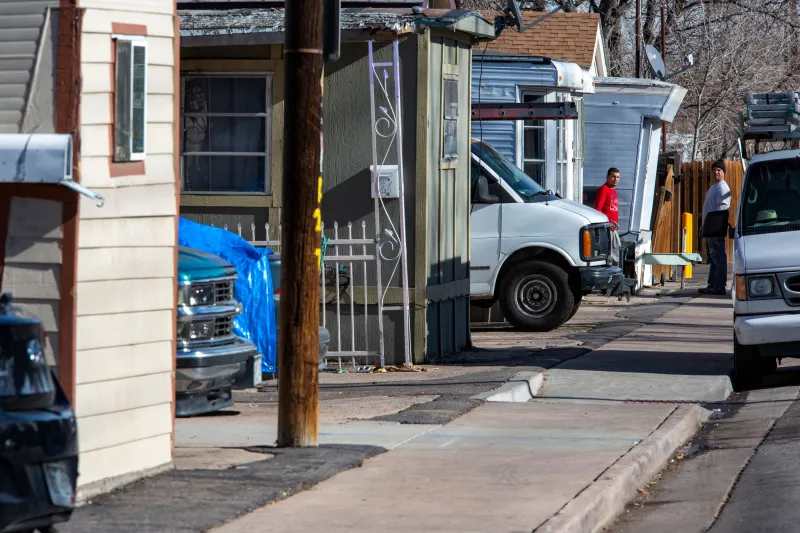
Photo: Denver neighborhood gentrification urban renovation community street, via newspack-coloradosun.s3.amazonaws.com
There's a particular kind of optimism that comes with writing a big check for a crumbling building on a block most people drive past without slowing down. It feels like courage. It feels like commitment. And sometimes — not always, but sometimes — it is.
But in Denver, that optimism has a complicated track record.
Over the past decade, a quiet experiment has been playing out across neighborhoods like Globeville, Elyria-Swansea, and pockets of the Far Northeast. Wealthy transplants drawn by Denver's growth, along with natives who left and came back with California equity in their pockets, have been buying into communities that the city's mainstream investment culture had long ignored. The pitch was usually some version of the same thing: We're not here to flip it. We want to build something real.
What happened next depends entirely on who you ask.
The Pitch and the People Who Made It
Take Marcus Ellroy — not his real name, but a composite of several investors we spoke with who asked for anonymity. He grew up in Aurora, moved to Seattle for fifteen years, built a career in tech, and came back to Denver in 2018 with enough money to do something he called "meaningful." He bought a mixed-use building in a neighborhood where the median household income hadn't budged much in a decade. He renovated it. He brought in a coffee shop and a small co-working space. He kept two residential units at below-market rent — at least for the first couple of years.
"I genuinely thought I was doing it right," he said. "I talked to people on the block. I went to the neighborhood association meetings. I thought I understood what was needed."
By 2022, the block looked different. Three other buildings had sold. Two long-running businesses had closed. The families who'd rented nearby for years were, one by one, gone.
Ellroy didn't cause all of that. But he's not sure he didn't contribute to it either.
The Signal Problem
City planners have a term for what Ellroy's investment likely triggered: a market signal. When money visibly moves into a neighborhood — especially the kind of curated, aesthetic-forward investment that comes with new tile and reclaimed wood — it tells other investors that the area is "turning." And once that signal goes out, it tends to attract capital that is far less interested in community benefit than the original investor was.
"The first person in often has the best intentions," said one Denver community development official who asked not to be quoted by name. "The problem is they don't control who comes in second, third, or fourth. And those people are usually just looking at the spreadsheet."
This is the trap that even the most well-meaning neighborhood investors fall into. They open a door they can't close. And in a city where housing costs have risen more than 70 percent over the past decade, that door opens onto something that can feel a lot like displacement.
Long-Timers Speak
Rosaria Mendez has lived in the same house in Elyria-Swansea for 31 years. She watched the neighborhood absorb the construction of I-70, watched it get overlooked by every major development push Denver went through, and she watched it start to change.
"Some of the new people are nice," she said, sitting on her porch on a Tuesday afternoon. "I'm not saying they're bad people. But nice doesn't pay my property taxes. Nice doesn't keep my neighbors from having to move."
Her property taxes have increased significantly since 2019. Her block, once almost entirely owner-occupied by long-term Latino families, now has three short-term rentals and a renovated duplex renting at rates she calls "science fiction."
She's not interested in whether the investors meant well. "Meaning well is a starting point," she said. "It's not a finish line."
When It Actually Works
It would be dishonest to say the experiment always fails. There are cases in Denver where outside investment has genuinely strengthened a neighborhood rather than hollowed it out — usually when it's structured around community ownership, not just community aesthetics.
The Globeville-Elyria-Swansea Community Land Trust has been working to acquire and hold property in a way that removes it from the speculative market permanently. Several investors who initially came in with the standard renovation playbook ended up redirecting money into that trust after conversations with longtime residents made the stakes clear.
"There's a version of this that works," said one board member. "But it requires investors to accept that they might not make as much money. And a lot of them aren't actually ready for that conversation."
Community benefits agreements — legally binding deals that tie development approval to specific commitments around affordable housing, local hiring, and anti-displacement protections — have also shown promise when enforced. The key word being enforced.
The Returning Native Problem
One wrinkle that doesn't get discussed enough is the particular dynamic around Denver natives who left, made money, and came back with a specific idea of what the city should look like. There's a nostalgia-tinged version of neighborhood investment that can be just as disruptive as the purely transactional kind — maybe more so, because it comes wrapped in personal history.
"I grew up near here," one developer told us. "I know what this neighborhood used to be."
But the people still living there know what it is. And those two things aren't always the same neighborhood.
The returning native often invests in a memory rather than a community. They want to restore something — a vibe, a character, an energy they associate with their childhood — without fully reckoning with the fact that the people currently living there have built their own version of that place. A version that doesn't necessarily need saving.
What the City Owes This Conversation
Denver's city government has been inconsistent, at best, in how it manages the tension between investment and displacement. Zoning decisions, tax increment financing, and infrastructure prioritization all send signals about where capital is welcome — and those signals don't always align with the city's stated equity goals.
"The city can't just let the market sort this out and then act surprised when communities get displaced," said one housing advocate who's worked in Denver for over two decades. "There have to be structural protections in place before the investment wave hits, not after."
That's the uncomfortable center of this whole conversation. Well-intentioned investors operating in a policy vacuum will almost always produce mixed results. The question isn't really whether their hearts are in the right place. The question is whether the systems around them are built to channel that investment toward community stability rather than community turnover.
Right now, in Denver, the honest answer is: not reliably.
The Check Isn't Enough
None of this is an argument against investment in historically underserved Denver neighborhoods. Disinvestment has its own brutal consequences, and the communities that have been starved of resources for decades deserve better than a hands-off approach that leaves them stranded.
But money, by itself, has never been a neighborhood strategy. It's a tool. And like any tool, what matters is who's holding it, who they're accountable to, and whether the people most affected by the work have any real say in how it gets done.
For Denver to get this right — and there's still time, though not unlimited time — the city needs investors willing to subordinate their vision to the community's, policymakers willing to enforce protections with teeth, and a public conversation honest enough to admit that good intentions and lasting benefit are not the same thing.
Rosaria Mendez put it plainly: "You want to invest in my neighborhood? Then invest in us. Not in what you think we should become."